


Just a quick post in appreciation of the month off of school I just had. Glory to God who gives us rest!
seeking the Lord's dwellings in simplicity
Just a quick post in appreciation of the month off of school I just had. Glory to God who gives us rest!

I am the kind of person who is prone to small, fiddly projects, like knitting a sweater in fingering weight yarn or translating Ovid because I don’t trust other people’s translation of the Metamorphoses. Because of this, I frequently get stuck in the middle of doing fine fiddly things that require concentration and more time than I feel these projects should rightly demand of me.
Because of this, I am often left with the question – is it actually worth doing these fine things, and especially is it worth doing these fine things well?
But more fundamentally, is it worth doing fine things at all? And is it worth doing things that take so much time?
Then yesterday, as I was journaling, I began to think about the slowness of things. The slowness of translations, the slowness of healing, and the slowness of struggle.
Fine things, hard things, are often slow, like working on a translation. In a translation, half an hour can yield this:
And she represents the earth struck by her spear
Metamorphoses 6.80-81, translation mine
Bringing forth a blossom of olive white with fruit
Is all this debate about the interpretation of a participle or whether or not this should be taken as a dependent clause or a prepositional phrase worth it? Perhaps.
Fine things like healing are often slow. I have been out of the hospital for not even two months, and I expect myself to be better and to do better, especially since my injuries are not visible on my body. Yet today, the feast of the Forerunner, was the first day in months I was able to make it through an entire Liturgy without leaving.
Is this, the process of putting myself back together with more exterior supports than I thought possible, worth it? Of course it is.
Fine things, difficult things, are often so slow they go at the pace of a snail, like the Christian struggle. Here, I hope I remember to say my prayers, and there, I hate that I forget. But slowly, the days that do build up, and they are the ones that change me.
Is this struggle for Christ worth it? Without any question at all.
These fiddly fine projects are slow, and moreover, they are not strictly necessary to my personhood. So why do I have questions about their value?
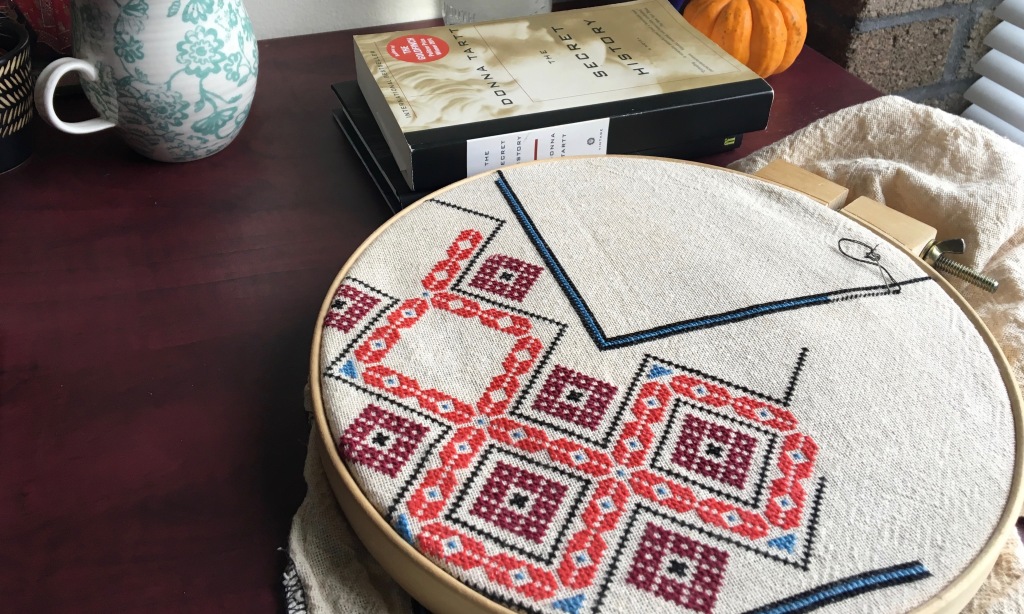
So this is the value of doing fine things well: each stitch, each word, gives me an opportunity to take one measured step at a time, to not rush the process, and to glorify Christ with every breath. This is what I need above all, and maybe by writing it down, I won’t forget.

Wherefore go I with downcast face whilst mine enemy afflicteth me?
Psalm 42/43:2, HTM
I am an Orthodox Christian, and I have a mental illness.
Essentially, I was recently diagnosed with a type of mental illness called Bipolar II, a mood disorder on the bipolar spectrum which is no less severe than Bipolar I but only differs in its reality. The easiest way to explain it is that in Bipolar II the highs aren’t as high (hypomania rather than mania) but the lows are lower (and perhaps last longer). (For more thorough explanations as well as one of my primary sources in explaining Bipolar II, please visit Dr. Jim Phelps’ website, https://psycheducation.org/, where he talks about symptoms, treatment processes, and the like.)
(Note: this post might sound a little detached compared to my usual writing style, but it is difficult for me to write about what happened without sounding detached. It is still new, so it still feels a little like a dream. In any case, please bear with me.)
I had been struggling with the possibility of my having a mental illness for a long time. Originally my spiritual father thought I had some kind of clinical depression, but then I was not seeking treatment for it because some days (sometimes for consecutive days) I would feel great and even on top of the world. Of course, this was actually another symptom of my mental illness, but the cycles messed with me, and so when I was depressed I was too lonely or too scared to seek treatment, and on days I felt on top of the world I felt I didn’t need to seek treatment.
During this time I felt like an emotional yo-yo, at the whim of feelings and thoughts I didn’t understand and didn’t want to experience; one of my dear friends said that in interacting with me I felt like a roller coaster on fire headed for a brick wall. Eventually this finally resulted with me being in what psychiatrists call a bipolar mixed state, where I was experiencing both symptoms of hypomania (extra energy, irritability, racing thoughts, inability to concentrate, not sleeping enough) alongside symptoms of depression (listlessness, lack of interest in my life, things I normally love not bringing me joy, general apathy, and sadness).
As you can imagine, this state was terrible. It finally got to a point where the emotions were all too much, and I had a day where I had three rounds of crying and not calming down because I simply could not handle basic stresses in my life. At this point, my spiritual father was of course deeply concerned about me, and he thought I needed go to the hospital so they could start treatment, since I was unable to calm down in the moment and I had also not been seeking treatment.
So, I went to the ER, and then was transferred to a psychiatric hospital. I spent a week and a half there, and it was so necessary and so lovely to be able to rest my mind, begin treatment, and start to heal.
Now I am back in my regular life, and I have been for about half a week. I am no longer a roller coaster on fire headed for a brick wall; instead, I am balanced and centered. I have been moving more slowly, prioritizing peace and calmness, and taking a little more time to notice the sunshine on my plants. Life is not going back to normal, but a new normal is here, and it is better than ever before.
Why art thou cast down, O my soul? And why dost thou disquiet me? Hope in God, for I will give thanks unto Him; He is the salvation of my countenance, and my God.
Psalm 42/43:5, HTM
This week I started having scheduled work again after having two weeks off. This was not particularly difficult in terms of the type of work I have to do (I work in a small bookstore), but simultaneously it was spectacularly difficult because I lost a large degree of creative control over my time during the day.
As irritating as this was, I suppose it’s a nice reintroduction into the world of prioritization and scheduling. In my last Sunday post, I wrote about how many obligations I’m going to have, and realistically the only way I am at all going to get through is prioritization, scheduling, and most of all the grace of God.
I think the biggest thing I’m going to have to remember is to slow down and remember God. In his book Becoming a Healing Presence, Dr. Albert Rossi talks about stillness and silence being a form of prayer. He is, of course, harkening back to Elijah’s finding of God not in the thunder, earthquake, or wind, but in the still quiet breeze. Interestingly, we Orthodox actually just read this 5 days ago as the third Old Testament reading for the Vespers of Transfiguration.
I suppose, then, that the only way I can transfigure my time into something positive and God-serving is to find the stillness and the silence and allow it to permeate throughout my day. More accurately, find God in the stillness and the silence and allow Him to permeate my life.
I suppose that’s what Dr. Rossi was really saying and it just took me a while to understand, but then, this is a life-long process, and I am just a beginner.


There comes a point sometime towards the end of July that I like to call “deep summer”.
Deep summer overlaps a bit with the dog days of summer, which apparently last from mid-July to mid-August (as I just learned from Google). However, deep summer is less of a date-oriented time and more of a feeling.
Deep summer happens when everyone realizes that in a month or so, school and “normal” life will start again, and in response, go into a sort of slower mode of existence in order to preserve as much as possible the luxurious feeling of not having a million things to do. Deep summer means the last chance to go on vacation and the last chance for a family cookout.
Deep summer means autumn is almost here.
With the arrival of autumn comes the arrival of classes and books and groups of people asking everyone in the cafeteria to sign up for intramural flag football (no). The arrival of autumn means I need to make sure I have notebooks and erasers for my mechanical pencil, and also a decent handle on the amount of work I’m going to have to do.
What on earth possessed me to become involved in student government, the leadership of a multi-seminary movement to promote brotherhood and Orthodox unity, the foundation of a creative writing group, and more or less sole responsibility for the proper order of chapel services, in addition to two part-time jobs and 15 credits of classwork, 6 of which are at a different college, the beginning of my undergraduate thesis project, and doctoral applications, in addition to getting a healthy amount of sleep, exercising a little every day, eating properly, having friends, doing hobbies which calm me down and keep me going creatively and introvertedly, and maintaining a decent spiritual life? What possessed me?
Deep summer is here. Hush.
I haven’t yet mapped out my complete class schedule yet because I do not know what it is, which frustrates me rather a lot. I don’t know if I’m even going to get into the classes at the other college, and yet I need them to graduate with my beloved classics major. I’m also not sure yet what graduate programs I’m going to be applying to yet. Simply looking at the list of all I will have going on is overwhelming to me.
Deep summer is here. Hush.
Now my question is, how do I keep this beautiful slow creative happy feeling with me when I start doing all of that stuff? How do I maintain my sanity after the craziness starts?
I think the best answer I can come up with is something my advisor frequently says to me when I am stressed or exhausted: Take care of Catherine for me.
I need to take care of Catherine, and Catherine likes quiet and being creative and cooking and reading every good classics fanfiction book under the sun. Catherine enjoys the profound freedom in reviving her inner toddler and saying no and sticking to it when asked to do something she is not interested in doing.
Catherine loves the hush of deep summer.
 Even Thine Altars