The Bridge of San Luis Rey (review)

Some say that we shall never know and that to the gods we are like flies that the boys kill on a summer day, and some say, on the contrary, that the very sparrows do not lose a feather that has not been brushed away by the finger of God.

Thornton Wilder, The Bridge of San Luis Rey

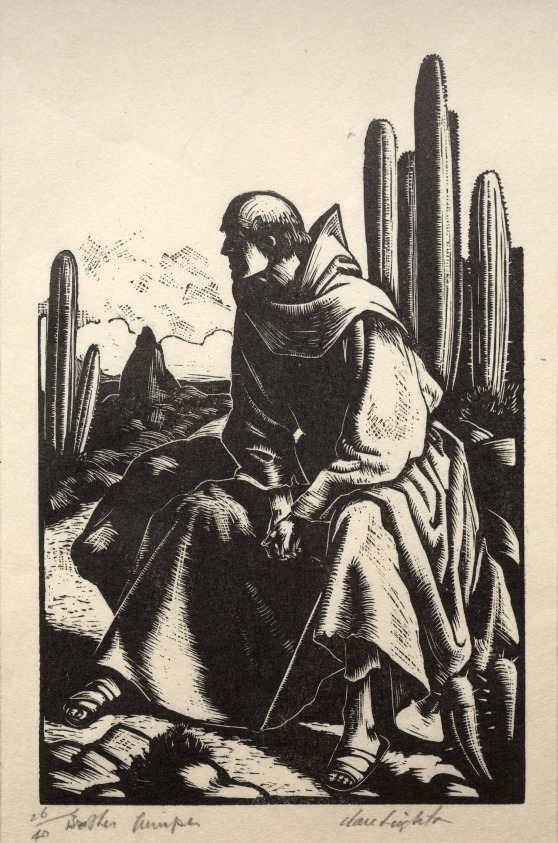
The Bridge of San Luis Rey is a novella by Thornton Wilder that opens with the bridge of San Luis Rey collapsing and sending five people to their deaths. The single witness to this event, Brother Juniper, decides at that moment to track down information on the lives of all of these people in order to prove scientifically the theological point that certain kinds of lives lead to certain kinds of deaths. He looks at the lives of Doña María (the Marquesa de Montmeyor) and Pepita, Esteban, and Uncle Pio and Jaime.

And I, who claim to know so much more, isn’t it possible that even I have missed the spring within the spring?

Thornton Wilder, The Bridge of San Luis Rey

Wilder weaves the tales of these characters together, tying them to each other through commonalities of place and acquaintance. The characters in the novella dance around each other, in and out of each others’ lives, sometimes directly and sometimes only barely, as through the friend of a friend.

She was one of those persons who have allowed their lives to be gnawed away because they have fallen in love with an idea several centuries before its appointed appearance in the history of civilization. She hurled herself against the obstinacy of her time win her desire to attach a little dignity to women.

Thornton Wilder, The Bridge of San Luis Rey

Overall: the writing in this book is absolutely phenomenal. It is lyrical, simple, terse, and elegant all at the same time. Wilder writes with clarity and with cutting truth, providing a painfully beautiful atmosphere in which he examines the impossible balance of predestination, divine intention, divine abandonment, and divine indifference.

All I can hope is that I do not end up like Brother Juniper.

*****
Look at these incredible woodblock prints at the Cleveland Museum of Art inspired by The Bridge of San Luis Rey

*****
This post is part of my 50 Classics in 5 Years series.
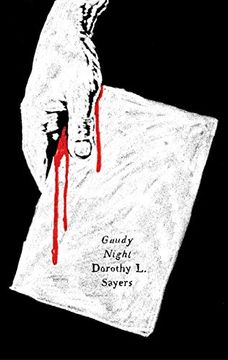
Gaudy Night

Dorothy Sayers’ Gaudy Night is not a novel one reads for entertainment. It is, perhaps, what one would call a slow burn; yet even this description does not fully encompass the semi-philosophical musings of a popular mystery writer contemplating the gains and losses of pursuing an academic life, all set in the warm embrace of what is ostensibly a Golden Age detective story.

Harriet Vane is not, in my opinion, a particularly interesting (or particularly empowering) character. I am not sure why in this novel, or in any of the novels featuring Lord Peter Whimsy and Harriet Vane, Miss Vane is such a weak character. On the one hand, Sayers portrays her as this brilliant and successful (if modest) mystery writer who can track clues (or drop clues, as the case may be) with the best of them, yet every time Harriet comes across a real-life mystery, she becomes completely inept and invariably needs Lord Peter to swoop in and rescue her. (This of course also becomes problematic because their relationship is inherently predicated on inequality, although I am not sure if Lord Peter picks up on this; Harriet is certainly aware, which just makes it worse.)

Now, I should say that I honestly do not mind a good damsel-in-distress trope, but in this context the use of the trope is completely baffling to me. The first Harriet Vane novel has a solid reason for Lord Peter to come in and use his mental prowess to exonerate Harriet of the murder charges levied against her, but every novel after the first one repeats the trope with progressively more questionable purpose.

Thus we come to the main point of the novel: women in academia. At the time Sayers wrote Gaudy Night, women were not allowed to maintain a career in academia and get married and have a family; the idea being that the one would detract from the more central purpose of the other. It is into this social context which Harriet arrives when she visits Oxford.

The main mystery of the novel seems not to be the mystery of the poison-pen but the mystery of Harriet Vane. Does she prefer the pursuit of her career, and potentially the transition from mystery writer to academic, thus barring herself from married life? Or would she prefer the married life, choosing to spend her days with Lord Peter, who is completely besotted with her? Sayers examines this question from many angles, which causes this already long novel to drag on seemingly forever.

I’m really not sure what Sayers is trying to accomplish with this novel. It’s not a terribly good mystery; resolving the question of the poison-pen seems to be completely forgotten as so much ink is spent on Harriet’s internal conflict. (Honestly, it reminds me of the end of Orson Scott Card’s Speaker for the Dead – the plot the reader cares about is resolved, the novel is done, but oh yeah there’s that one thread about that fleet sent by Starways Congress that we forgot about, oops.) The story is confusing and meandering; there are too many characters, settings fall in and out of relevance, and the tone floats between lighter narrative and heavier philosophical.

Yet despite all of this, I actually really enjoy this novel. I’ve read it twice (I’m not sure I will read it again, at least for a while), and while the first time I read it for the romance, the second time I read it for the reflections on academia. I always thought that academia was one of the better careers to have while also having a family and being a mother, but there are always sacrifices one has to make, and in the end, I don’t know if anyone will ever have a truly good answer for the balance needed to both work and have a family. Sayers, knowingly or unknowingly, points out through the plot the classism inherent in being an academic and having a family versus being the help and having a family – both are societal impositions, but the academics are supposed to give up family and the help are expected to be able to manage without much or any aid from the people who “create” their jobs. It is certainly thought-provoking, and in the end, I think that is the most succinct way I can review this book.

(This is post 4/50 for my 50 Classics in 5 Years challenge. Time left: 2 years, 6 months.)

Death Comes for the Archbishop

Death Comes for the Archbishop (Vintage Classics): Cather, Willa:  9780679728894: Amazon.com: Books

Men travel faster now, but I do not know if they go to better things.

Willa Cather, Death Comes for the Archbishop

Willa Cather’s remarkable novel Death Comes for the Archbishop is a book I never thought I would pick up. If I remember correctly, I started reading My Antonia several years ago and couldn’t really get into it, so I put Cather aside and went a different way. Then, a friend reached out and wanted to reinstate an on-again-off-again book club that has clung to life for a few years now, and the book chosen for this iteration was Death Comes for the Archbishop.

Although I picked up the novel with reluctance, I was very quickly drawn into the story of the intertwined lives of Father (Bishop) Jean Marie Latour and his assistant and faithful friend Father Joseph Vaillant. What struck me most at first were the place names — it was so odd to be reading a “classic” novel that mentions the Pueblos of Pecos and Isleta and Taos; the cities of Santa Fe and Albuquerque and, later on in the novel, Denver. These are places I have grown up around and in; I have seen road signs for some of these towns and I have driven through others; their names are familiar and their landscapes are comforting.

I have no idea what it would be like to read this novel and not know in my bones what the land feels like in New Mexico, but I imagine that even from just Cather’s words one can pick up a clear sense of the land, in its harshness and its beauty. She can depict a landscape better than Tolkien, down to the sound a sunset makes. Similarly, she can capture a human soul in a few clear strokes, whether she is showing the simple faithfulness of an illiterate Catholic or the complex cultivation of an educated Cardinal.

Where there is great love there are always miracles.

Willa Cather, Death Comes for the Archbishop

In many ways, this book reads like a hagiography. It is a work of fiction, even if it is based on the actual bishop who was first sent to the New Mexico territory to take care of a burgeoning and unguided flock. And yet — Cather truly captures something of holiness in the struggles and sacrifices made by Bishop Latour and Father Vaillant as “the rivers of their tears cultivated the barrenness of the desert” (as the general apolytikion for an ascetic so beautifully says).

In a year when Bertrand Russell published his essay “Why I Am Not a Christian” and existentialism reached a peak in Martin Heidegger’s Being and Time, how could a small novel by an American author contain a line that better fits the Akathist to the Mother of God than it does contemporaneous literature?

The nursery tale could not vie with Her in simplicity, the wisest theologians could not match Her in profundity.

Willa Cather, Death Comes for the Archbishop

You should read this book.

(This is 3/50 for my 50 Classics in 5 Years Challenge.)

Alcestis

Alcestis by Euripides is a story I have been somewhat obsessed with ever since I first heard about it during my Readings in Ancient Greek Drama class last fall. Should I have read it then? Yes. Was I also dealing with a great many things beyond my control? Also yes. So, here we are.

The story of Euripides’ Alcestis essentially consists of a wife (Alcestis) agreeing to die in her husband’s place since his parents will not do it; after she has had two children, the god of Death comes to collect, and thus she must die. Then Herakles comes to visit her husband (Admetus); he provides a warm welcome despite being in mourning, and after discovering this deceit, Herakles goes to the god of Death and brings back Alcestis.

Two points are worth mentioning here: first, that because Alcestis agrees to do this for her husband, she is considered the “best of wives and best of women” (to borrow a phrase from that most glorious of musicals, Hamilton) of all ancient Greek women. This is so much so that she was generally considered to be a model of womanly virtue. The second thing worth mentioning is that Euripides actually modifies the original folktale version of this story, in which Alcestis dies on her wedding night and then the gods (not Herakles) bring her back to life in admiration of her womanly virtue.

In any case, this story has always made me incredibly angry. Why did Alcestis have to agree to give up her life for a man she had barely met in order to be considered the best of wives and best of women? Why, in Euripides’ version, did her sacrifice have to be practically negated by Herakles’ rescue? Why, in Euripides’ version, does she not speak after her rescue (a point which is conveniently explained away as a necessary three-day purification from the rites of death)?

And most of all, why can I not explain these things even to myself?

Despite this story making me very angry, I still enjoyed reading the play. It is, like most plays (even ancient Greek ones), a quick read. The action moves along swiftly, and in keeping with tradition, all the action happens within a “dramatic day” (all the action in ancient Greek plays happened within a span of twenty-four hours).

My main takeaway from reading the play rather than simply knowing the story is that Admetus is an even bigger cad than I originally thought he was. He is cowardly, yes, for trying to have someone die in his place (there was a deal with Apollo at some point that allowed this), but then his completely over-the-top mourning upon the death of his wife who willingly agreed to die for him is just so much. Too much, really.

The last thing I want to say is that I have been channeling my anger from this story into a series of poems about Alcestis (so far I have eight, and I hope to have a whole book of them someday). One of them is a rather remarkably clever limerick about Alcestis meeting Theseus in the Underworld (since he and his bestie Perithoos went down to try to abduct Persephone to be Perithoos’ bride, and then obviously were captured by our good man Hades and got punished by having their bums stuck to rocks until Herakles came and rescued them), even though she probably never got that far (since she hadn’t passed over the Acheron – not the Styx – with Charon yet). Still, it’s funny, and I always thought it would never see the light of day, but here we are. Enjoy!

Alcestis V. Theseus.

I once met a man who was Athenian
Who told me I was quite a bohemian
But his rear was stuck
And mine beat his luck
But we both got the treatment of the tragedian.

(This is book 2/50 for my 50 Classics in 5 Years Challenge.)

(Public Domain Image from Wikipedia. Scenes from the myth of Admetus and Alcestis. Marble, sarcophagus of C. Junius Euphodus and Metilla Acte, 161–170 CE. By Unknown artist – Jastrow (2006), Public Domain, https://commons.wikimedia.org/w/index.php?curid=1302577)

Mere Christianity

C. S. Lewis’ Mere Christianity came at a timely point in my life. Lent started; church was hard. COVID-19 happened; church was banned. Then, I decided to pick up this book, because not going to church was easy, and staying away from church felt normal.

So I was faced with what is part apology for Christianity and part challenge to become a Christian. The part of me that really likes where I’m at right now resisted this challenge, but the quiet part of me that used to really love going to church started to raise its head. It reminded me that at one point I wanted change in my life, and that the good things I have right now are gifts that even several months ago I was begging to have. All that is to say, this book had an impact on me.

Mere Christianity consists of three parts. The first is about the challenge which the existence of morality essentially poses, the second is about Christian morality particularly, and the third is a sort of explanation of basic Christian doctrines.

In the first part, I found Lewis’ critique of Dualism insightful, as I had not thought about the fact that by labeling one power “good” and the other “evil” we are essentially passing judgment on them. His ideas about the source of the idea of good being an Entity (Person) above all of us which guides us rather than forces us to do things made a lot of sense to me.

The second part I found easiest to read of all three, as I have grown up Christian and much of what he wrote was already familiar to me. Here he introduced the idea that in order to practice love (the most essential of all Christian virtues), you really need to do exactly that: practice. One does not start out by being able to love perfectly, but by practising love of neighbor and by practising love of God one can get better at it.

This sort of theme of you don’t start out perfect was continued in the third part. We are commanded to be perfect, yet we are not perfect; the reconciliation of this occurs when we give ourselves fully to Christ and allow Him to make us perfect through the “good infection” of His presence. One point Lewis kept making here is that we do not become Christians to become nice people but to become good men.

Once there was a time a couple years ago when I started reading this book. I did not get very far that time. Reading it now, it has moved me and caused me to think in a way that would not have been possible when I originally tried to read it. It is so nice to read a book about theology that was written in my native language and not in a translation of the Greek; the Fathers of the Church can teach us so much, but often the language is not as natural as what I found in Mere Christianity.

As is so often the case, this book entered my life exactly when it needed to, and I am very grateful for that. Lewis reminded me of faith and challenged what little I have, and I hope that this book will continue to make me think more deeply about the nature and challenge of Christianity.

(This book is 1/50 for my 50 Classics in 5 Years Challenge.)

50 classics in 5 years

One of the blogs I follow, The Classics Club, is centered around the challenge of reading 50 classic books in 5 years. Now, given that I am a “classics” major, I need to specify that this means any book that is considered a “classic” rather than any book from the period of Classical Greece or Rome (although a couple of those certainly made my list).

In order to participate (and I will be!), I have to put a list of the 50 books I want to read on my blog. So, here it is! For the sake of simplicity (as well as my own sanity), I have alphabetized it, and I will be updating this post as I read the books, and linking to reviews as I post them.

This is slightly an intense commitment for me, because aside from my college degree this is the longest commitment I have made to anything. We shall see how it goes! (And I hope you all like books because it’s going to be very book-ish around here for a while…)

Start date: June 2020
End date goal: June 2025

  1. Achebe – The African Trilogy
  2. Alcott – Hospital Sketches
  3. Alfred, Lord Tennyson – Idylls of the King
  4. Aristotle – Poetics
  5. Angelou – I Know Why the Caged Bird Sings
  6. Anonymous – Homeric Hymns (trans. Sarah Ruden) (NB: although called Homeric Hymns, they are not actually by Homer, hence “anonymous”)
  7. Anonymous – The Way of the Pilgrim
  8. Apollonius Rhodius – Argonautica
  9. Aristophanes – Lysistrata
  10. Barrie – Peter Pan
  11. Brontë (Charlotte) – Vilette
  12. Brontë (Emily) – Wuthering Heights
  13. Cather – Death Comes for the Archbishop
  14. Dante – The Divine Comedy
  15. Dostoyevsky – The Brothers Karamazov
  16. Dostoyevsky – Notes from Underground
  17. Eco – The Name of the Rose
  18. Eliot – Middlemarch
  19. Euripides – Alcestis
  20. Euripides – Herakles Furens
  21. Euripides – Hippolytus
  22. Euripides – Ion
  23. Euripides – Medea
  24. Hemingway – The Old Man and the Sea
  25. Hesiod – Theogony
  26. Knowles – A Separate Peace
  27. Leroux – The Phantom of the Opera
  28. Lewis – Mere Christianity
  29. Lewis – The Screwtape Letters
  30. Lewis – The Space Trilogy
  31. Orczy – The Scarlet Pimpernel
  32. Ovid – Metamorphoses (trans. Charles Martin)
  33. Plath – The Bell Jar
  34. Salinger – Franny and Zooey
  35. Sayers – Gaudy Night
  36. Shakespeare – The Tempest
  37. Shakespeare – Othello
  38. Shelley (Mary) – Frankenstein (1818 version)
  39. Sophocles – Philoctetes
  40. Spenser – The Faerie Queen
  41. Stoker – Dracula
  42. Tolstoy – Anna Karenina
  43. Tolstoy – War and Peace
  44. Virgil – The Aeneid
  45. Vonnegut – God Bless You, Mr. Rosewater
  46. Walker – The Color Purple
  47. Wharton – The Age of Innocence
  48. Wilder – The Bridge of San Luis Rey
  49. Wilde – The Picture of Dorian Gray
  50. Woolf – To the Lighthouse

Updated 1/10/21 to remove 2 Jane Austen novels (I don’t like her; don’t hate me) and Dickens (I also don’t particularly like him), as well as Strout’s Olive Kitteredge because I found it boring.

I’m also going to be joining up with Sue Jackson’s 2020 Big Book Summer Reading Challenge, so I can start getting through some of these. There are several on this list which are over 400 pages which I could tackle. I am most likely going to start with Jane Austen’s Emma, and then we’ll go from there! With all that said, I have a ton of reading to do now, so let’s get this party started!

yarn along June 2020

This month is a solidly summer month, filled with berries and scones and grilled meat (at least until the Apostles Fast starts). I have been steadily working on many things, such as sock patterns from 52 Weeks of Socks and also many books.

The most exciting thing I have been working on is my Etsy shop! I am selling handmade wool prayer ropes. I have been wanting to do this for some time now, and I finally got around to it, now that I have enough inventory to actually fill some orders. 10% of all profits will go to support Orthodox Christian mission work in Albania. (If you want more information on that, please go here. I had the great privilege of visiting Albania as part of a missiology class I took, and I loved it very much and I really hope to go back someday.)

In my previous blog post, I mentioned that I read 11 books in the month of May. Some of these were fairly short, like The Little Prince by Antione de Saint-Exupéry, or Transcendental Wild Oats by Louisa May Alcott. Some I had already started, like Becoming a Healing Presence by Dr. Albert Rossi, or Things Fall Apart by Chinua Achebe.

This month I hope to keep up with this amount of reading (if not more). I really want to finish Louisa May Alcott’s A Long Fatal Love Chase and Charlotte Brontë’s Jane Eyre, as well as Fr. Thomas Hopko’s really wonderful book Doctrine and Scripture (here I should mention that SVS Press is having a 50% off sale right now, so if you’re interested, go check that out). I also want to read Further Up and Further In by Edith Humphrey (also an SVS Press book), since it was part of a graduation present from my church. I could list more, but my reading is very prone to changing as time goes on, so I don’t want to overcommit here!

As far as knitting goes, I am working on another pair of socks from Laine’s 52 Weeks of Socks. This pair (pattern #1 in the book) is in a deep purple from Farmers Daughter Fibers held with a strand of Shibui Knits mohair in a similar color. They have such delightful cables!

I am also working on finishing my gray Honey Study Hat (pattern by Andrea Mowry in one of my Taproot magazines). At this point I’m really hoping to have enough yarn to get through the crown, but I might have to introduce a yarn in a similar color and weight to finish it. Fortunately I have one, so this shouldn’t be a problem, but the texture difference between woolly wool and soft alpaca might be a bit obvious. We shall see!

I hope you are all doing well and taking care of yourselves!

(Joining up with Ginny’s Yarn Along)

(All the links to Bookshop are affiliate links, which means you can support me a little while supporting independent bookstores!)

so many books in May

So far I have finished 10 books in May (strong emphasis on the finished). Still this is a rather ludicrous number of books to have finished in one month, especially considering that it is almost double the rest of the books that I have read this year. 

So, I wanted to pause for a moment and reflect on at least a few of the books that I have finished, some good, some bad, and some ugly. To keep the ending vibes positive, we will work from the bad to the good. 

First up are two books which I ultimately did not like: Rupi Kaur’s The Sun and Her Flowers and Leigh Bardugo’s Ninth House. Rupi Kaur’s book stank of modern pseudo-feminist Instagram poetry, which appears to be empowering and liberated but is merely overly sexual. I did not finish it, since it only appeared to get worse as the book went on. Ultimate rating: 1 star (because I can’t do 0 stars on Goodreads).

Ninth House was better than this; it was a good romp and I enjoyed reading it. This book is about a girl named Alex (aka Galaxy) who gets caught up in some magical secret societies at Yale; also there are ghosts. I knocked off one star for the profane content (aka trigger warning material, of which there was a great deal), another star off for choppy pacing, and a final star off for the mystery part having one too many plot twists. I can appreciate a few good twists and turns in a dark mystery novel (in fact, they are compelling), but after a certain point, they just cease to be believable. Ultimate rating: 2 stars. 

Next up is a spur of the moment read which I picked up via Kindle through my library’s Libby app. (Stay at home/ quarantine has given me a newfound and very deep appreciation for this app; if you have a Kindle and aren’t using the app, you need to. Like right now.) This book was Tara Westover’s memoir Educated, which took me a single night to read because I found it so compelling (and was dealing with some infrequent insomnia). This memoir chronicles her leaving her fundamentalist Mormon family and the implications of that throughout her life, which was really interesting to see since she wrote about how the separation kept dragging on and on because the ties of familial love are (naturally) so strong. Her work resonated with me a great deal, and in some places made me cry. Ultimate rating: 5 stars (mostly for emotional reasons, and if I’m going to rate someone’s actual life it sure isn’t going to be any less than 4 stars). 

Finally are two pop sociology books, Cal Newport’s So Good They Can’t Ignore You and Amanda Ripley’s The Smartest Kids in the World. Cal Newport’s book examines the dichotomy between following your passion and designing your career to suit a niche and thus profitable audience. I honestly suffered through thus book, since I thought it was merely an extention and more “grown up” version of his philosophy developed in How to Be a High School Superstar. However, I finally finished it, and all I can say is he really harps on that whole “don’t follow your passion” thing. Which gets more irritating when you realize that it’s a false dichotomy, and all the people whose careers he examines picked something they liked and just followed it through to its natural extent. (Now there’s a controversial topic….) Ultimate rating: 3 stars. 

Amanda Ripley’s book was one I started four years ago when I was an secondary education English major at the Metropolitan State University of Denver, and I read about half of it on the train to and from school. I found it in my bedroom and decided to finish I remembered it being good. Ripley essentially examines the factors that go into getting a “good” education, from quality of teachers to money spent per student to socioeconomic background of the student (and more). She then compares these aspects across several countries with some of the highest-performing students, and with these in mind looks at what the USA is doing right and wrong. It is a fascinating book, and I highly recommend reading it. Ultimate rating: 5 stars. 

So, there are some of the books I finished during the month of May! Obviously there were more, but I didn’t want to overwhelm the post, so maybe I’ll do another one! I really love writing book reviews like this, and if you like reading them go ahead and like this post or comment or something so I know I should do them more frequently. 

Blessings to all,

Catherine

may 2020

The ending of April and beginning of May have carried a huge amount of weight for me in such a good way! I finished my thesis, did my last week of classes for my undergraduate degree, and took my last finals, and now I am approaching my first summer as a college graduate! (I suppose I should mention that I do have to take one more class for my science credit over the summer, but this should be fun and I’m not counting it because I’m taking it online at a local community college anyway…)

My graduation present to myself also came, which is Laine’s beautiful 52 Weeks of Socks book (which I guarantee is sold out again so I’ve linked to the Ravelry page showing all the patterns)! I preordered a copy of the fourth (!) printing run, and it showed up right before my finals began. This was of course very exciting, and I couldn’t wait to cast on. I originally chose sock number 51 using a La Bien Aimee sock yarn held double to get the gauge, but this ate through the yarn and there was no way I would have had enough. So, I frogged it and cast on another sock with the same yarn but held single. This worked out beautifully, and now I have one whole sock, which I am very proud of. Hopefully I can get through Second Sock Syndrome and finish the second and have my first properly fitting functional pair of socks made with my own two hands.

This whole sock knitting adventure has only just begun, and at the rate I knit, I’ve got years to keep exploring the wonderful world of socks. I really want to get some thicker sock yarns, like Tukuwool and Quince and Co’s Finch (or Tern if I’m really feeling luxurious). There’s another one, Onion Yarn, which is a Norwegian blend of wool and nettle fiber that I really want to try. (One of my favorite Instagram sock knitters used it in a couple of pairs of socks, and it’s absolutely beautiful.)

In terms of book news this last month, there honestly isn’t much beyond M. L. West’s Greek Lyric Poetry and Plutarch’s The Rise and Fall of Athens: Nine Greek Lives, both of which were for school. I think my favorite of the Greek lyric poets are Sappho for her incredible use of images of nature, Solon for his meditations on citizenship, and Stesichorus for Geryon, followed by Bacchylides for his use of color and imagery which just aren’t in Pindar (Bacchylides is not in the M. L. West volum). Of Plutarch’s biographies selected for the book, my favorite was Themistocles. There was this beautiful line about the tapestry of life that just got me, but then I am always completely taken by textile metaphors…

I also reread Oedipus at Colonus by Sophocles and Helen by Euripides (both from this volume). Helen is such a romp, and I love the way Euridipes explores power dynamics between women and men even in Menelaus and Helen’s relationship.

In a more religious vein, I am reading a short book, How Can I Learn God’s Will? by Fr. Daniel Sysoev. The first three quarters of the book is about God’s love and the Divine Names, which is very in line with St. Dyonisios the Areopagite’s On the Divine Names (which I really want to read soon). Only the last quarter is about learning God’s will, and it is quite practical. I am also reading The Ruthless Elimination of Hurry by John Mark Comer on my Kindle (this COVID-19 situation has given me a profound appreciation for the ebook lending part of the library). It is good in its ideas, although sometimes difficult for me to read, because of its modern self-help language and expression.

What are you working on and reading these days?

With love in the risen Lord,

Catherine

(Joining up with Ginny’s Yarn Along this month)

the end of an era

As I am writing this, I am approximately two weeks away from being done with all of my classes of the second semester of my senior year. In other words, I’m almost done.

This, as you can imagine, brings up all kinds of feelings, especially because I have to finish my degree in quarantine (or whatever we are calling this situation right now). I am nostalgic for my campus, stressed about finishing all my work, at a point where I am apathetic towards my work, and basically terrified about what comes next.

The great big future is before me after this, and there are no right or wrong answers about what to do. I have done what is socially acceptable, and now (young) adulthood is here on the very visible horizon.

Of course, I have been working towards going to grad school, but at this point it is not in my immediate future, and I have a year to fill. A year of reflection and solitude, a refresher year after this degree I just finished. (If you can’t tell, I’m a big believer in gap years.)

I’m excited to read a lot. I’m also excited I found a platform which supports local bookstores (bookshop.org). I’m also excited to announce that I registered for an affiliate link on bookshop.org. You can find my shop here if you feel like supporting it in any way. I made some shelves with books I like and a few books I want, but go ahead and explore the whole website. Support those indie bookstores! (…and maybe support me too, if you want…)

I suppose I should mention that I was (and still am) really opposed to registering for an affiliate program with Amazon, because of the monopoly they hold on Internet shopping. Basically, the fact that this exists makes me happy, and I am glad to support them (and I probably would link to them now anyway, so there’s that).

I might do a book review and updated TBR comparing what I have read with what I want to read. That will definitely happen after May. I also have some project updates and some other things in the works that should be coming along soon after I get some abundant quantities of free time.

Until then, God bless, and I will see you tomorrow on Pascha!

-Catherine