march downfalls, and some thoughts on prayer

Some brothers asked Agathon which good work required the most effort. He replied, “No labor is more difficult than prayer. Demons understand that prayer is a path to God. They will do everything possible to hinder this journey. Prayer is like fighting a war.

By Way of the Desert, entry for March 4

This month literally brings with it the beginning of Lent for us Orthodox folk, which is a beautiful as well as a stressful time. It always feels as if there is more to be concerned with, when really this time is about focusing on the one thing needful.

I have been doing a lot of reading for school, mostly Pindar with a side of St. John Chrysostom and a bit of Herodotus thrown in for good measure. My favorite is the Philokalia, which I am working through in a non-linear fashion because apparently that is how one is supposed to do it. If anyone wants to know this order, please let me know through email or whatever, because this way definitely beats cracking open Volume 1 and starting with, “There is among the passions an anger of the intellect, and this anger is in accordance with nature.” Oof. Start in the middle of Volume 4, my friends. It is much easier.

For personal reading, yesterday I (re)read from start to finish C. S. Lewis’ classic The Lion, the Witch, and the Wardrobe. I would say it was a delight, which it was, but it was also very challenging, because I’ve been in a bit of a rough patch recently spiritually. It’s all good and probably means I’m growing, but you know when an allegorical children’s book is challenging, things are rough.

On the same spiritual front, I’m about halfway through a book called The Divine Flame, which is a book about a divine flame that St. Porphyrios lit in one man’s heart, which inspired him to become a monk. I’m obsessed with St. Porphyrios; he’s absolutely wonderful and has been very active in my life, so this book is very dear to me. I actually got the copy as a gift when I was visiting his monastery (the Hesychasterion of the Holy Transfiguration), which is near my monastery in Greece.

I’ve also been reading Erin Morgenstern’s The Starless Sea for my book club. It’s a literary ode to the story, which despite its relative lack of a plot I don’t mind overmuch, but one does have to acclimate to her writing style. Alongside that, I’m (still) reading Chinua Achebe’s Things Fall Apart. I really should finish it, but school and spiritual reading has been taking priority recently.

After writing all that it occurs to me that I’m reading a lot of things simultaneously. I’ve always done this, it keeps me entertained. Since the whole going on brain meds thing has happened, I’m at least a lot better at finishing them, which is nice.

As far as crafting projects go, I’m working on the same sweater and the same embroidery and many of the other same projects as recent posts will mention. I’ve also started a Honey Study Hat (pattern by Andrea Mowry, because apparently I’m addicted to her patterns) in a lovely gray wooly wool that didn’t have a label. I will say, brioche stitch is much easier than I thought.

Whether it is at night or during the day that God grants you the gift of praying with a pure intellect, undistractedly, put aside your own rule, and reach towards God with all your strength, cleaving to Him. And He will illumine your heart about the spiritual work which you should undertake.

A Discourse on Abba Philimon, from the Philokalia

P.S. I’m sorry about the lack of pictures, but my room is a mess and I really couldn’t be bothered to take any. So writing it is.

(linking with Ginny’s Yarn Along)

projects and reads: February 2020

Recently I have been trying to finish many of the projects that I started a while ago, such as my sweater now formerly known as the Christmas sweater (I am stuck on that infamous place, sleeve island, on this one). Thus, armed with high hopes and great intentions, I instead cast on for another project.

Now, you could say that this is the continuation of a project I have been working on for some time, since I bought the pattern almost a year and a half ago, and have started it at least two different times, but now I think it is the time for finishing my very own Find Your Fade. I am starting with a skein of a white speckle I picked up at one of the yarn shops here in Boston, then I will be using a few skeins of La Bien Aimee, and a skein of Farmer’s Daughter Fibers. I think it will turn out very well.

Currently, I am reading Chinua Achebe’s Things Fall Apart (for fun) as well as J. N. D. Kelly’s Golden Mouth: The Story of John Chrysostom (for school). In Achebe’s novel, I am really loving the exploration of the spiritual aspects of the traditional African tribal culture he depicts. I think that kind of really immediate connection to the spiritual or divine is something the West has really lost, so seeing it be very present in another culture is wonderful.

Golden Mouth is a thorough biography of St. John Chrysostom which uses his main biographers as sources but supplements with other historical information. So far I have read about St. John’s early childhood and the general conditions of Antioch in the 4th century AD, as well as his conversion to Christianity and his dedication to the ascetic life.

As a mental health side note, the February (and pre-Lenten) blues are upon us. So, here’s a quote from Mother Gavrilia:

Never ask: “Why has this happened to me?” When you see someone struggling from gangrene or cancer or blindness, never say, “Why has this happened to him?” Instead, pray to God to grant you the vision of the other shore… Then, like the Angels, you will be able to see things as they really are: everything in God’s plan. Everything.

Mother Gavrilia
My working desk

(Joining with Ginny’s Yarn Along on this first Wednesday of the month)

new novels: a 2020 TBR

As the turn of the decade approaches and the light of a new year begins to dawn, it is again time to set ambitious goals for all areas of my life, most importantly reading. (But also knitting. We can never forget knitting.) Thus, without further ado and in no particular order whatsoever, here is my 2020 To Be Read list.

1. Ovid’s Metamorphoses translated by Charles Martin. My thesis is on Book 6 of Ovid’s Metamorphoses, so I think it might behoove me to read the whole thing. I read part of Book 6 from this translation in Barnes & Noble, and it reflected my translation choices and style, so it has become the necessary volume to acquire. Category: none, or a complete book of poetry by one author.

2. Euripides’ Alcestis. The story of Alcestis has always bothered me, and I have taken to writing poems about it, yet I have not officially read the text. This is, of course, a problem with a very easy remedy. Category: ancient Greek drama.

3. Any novel by Virginia Woolf. Category: an intimidating book, a classic book by a female author. I’m still torn between books, because all of hers are considered classics, and as much as I originally wrote Mrs. Dalloway on my TBR, I also really want to read To the Lighthouse because Ursula Le Guin spoke so highly of it.

4. Killing Commendatore – Haruki Murakami. Category: a foreign (non-western) book.

5. Eden’s Outcasts – John Matteson. A biography of one of my favorite writers of all time, the incomparable Louisa May Alcott. I went to the Orchard House in Salem, MA, last year, and I picked up a copy there. Also it won the 2008 Pulitzer for Biography. Category: biography or memoir.

6. Homer: Understanding Classics – Jonathan Burgess. A book by one of my favorite classicists of all time (after Dr. Nagy of course) and a gift from my academic advisor. This book apparently has a chapter on applying literary critical theories to the classics, which I desperately need to read. Category: a book of essays, a “guilty pleasure” book.

7. The Starless Sea – Erin Morgenstern. This one came out this past November, and I had pre-ordered a copy since I loved Morgenstern’s first novel so very much.. Hopefully I will read this with a small group of literarily-minded friends, but I will read it either way. Category: a contemporary novel.

8. Interior Castle by St. Theresa of Avila, or The Little Way by St. Therese of Lisieux. Most likely I will read Interior Castle because I own a copy, but I believe the school library has The Little Way, so it could be the same difference. Category: a devotional work.

9. The Idylls of the King by Alfred, Lord Tennyson. A retelling of the Arthurian legends in the most idyllic rather epic poetry of the only semi-Romantic I can actually stand, Tennyson. Category: a complete volume of poetry by a single author, reread a book you read in high school.

10. Shakespeare’s The Tempest. Apparently this is one of the last plays Shakespeare wrote, making it the Shakespearean equivalent of Euripides’ Bacchae. Clearly, anything vaguely Euripidean is worth reading. Category: a Shakespeare play.

Somehow the list kept getting longer…

11. And Then There Were None – Agatha Christie. Category: a classic detective novel, a classic book by a female author.

12. A Gentleman in Moscow – Amor Towles. Quite a famous book, recommended by a good friend whose recommendations never fail me. I will admit, I am about halfway through it even though it is just barely January 1, but I am loving it. Category: a historical fiction novel.

13. God Bless You, Mr. Rosewater – Kurt Vonnegut. Category: an “out of your comfort zone” book, a satire.

14. What Is Not Yours Is Not Yours – Helen Oyeyemi. Recommended in one of John Green’s videos. Category: a collection of short stories.

15. Reading Lolita in Tehran – Azar Nafisi. Category: a foreign (non-Western) book, a memoir or biography, a book about books.

16. The Little Prince – Antoine de Saint-Exupéry. Category: a classic children’s book.

17. The 7 1/2 Deaths of Evelyn Hardcastle – Stuart Trenton. A modern mystery, apparently inspired by Agatha Christie’s And Then There Were None. It will be fun to compare them. Category: a contemporary novel.

18. Olive Kitteridge – Elizabeth Strout. I have been seeing this on the bookstagram, and it also won a 2008 Pulitzer, this one for Fiction. I have been attempting to read more Pulitzer-prize-winning novels, so this one fits the bill most excellently.

19. Rumpole of the Bailey – John Mortimer. This one was recommended by my academic advisor, and since her taste tends towards the excellent, here we are.

20. Stories of Your Life and Others – Ted Chiang. Also recommended in a video by John Green. This collection of short stories is sci-fi, and it has been a while since I read any sci-fi, and it’s about time to remedy that. Category: a collection of short stories.

And because I am really quite daring, I decided to include five alternates, because if 20 isn’t already unrealistic for this final-semester-soon-to-start-real-life-college-senior, then 25 certainly is. (And let’s not forget all the reading I will have to do for school….) It is totally doable. I think.

1. Philology – James Turner. A Christmas present from my parents, this book is a monograph about the impact of philology on the modern humanist academic sciences. I am very excited to read it, however dense it may be (and however long it may take me).

2. Words of the Heart – Gerondissa Makrina Vassopolou. This has her life and 64 (!) of her homilies. I have read sections of this, and it is so helpful and her words are so direct and sweet, and I really need to read more spiritual books.

3. Idiot Psalms by Scott Cairn. Another Christmas present, and one I am very much looking forward to.

4. Life of the Virgin – St. Maximos the Confessor. I want to keep working through this one, since it is a bit dense, but so beautiful.

5. Virgil’s Aeneid. Because if I graduate as a classics major and have not read the entirety of this book in translation, something will have gone horribly, horribly wrong.

If you have gotten this far and read through all of that, bless you and your angelic patience with my ramblings.

What book are you most looking forward to reading in 2020?

Christmas sweaters and Advent books

Before the snow fell
Our current winter wonderland
Yarn that feels like frozen sparkling snow
Reading and research…
Dorm room Christmas decorating

It’s finally snowing here in Boston, and I am so happy for it! We are coming off of two consecutive snow days after a week off, so I have been luxuriating in the hygge (and, sadly, the procrastination…)

In that vein, I had a lot of goals for the month of November that got fairly well interrupted by a week and a half hospital stay. Fortunately now that’s starting to be sorted out, and now that I finally have more energy and I have the ability to focus focus (two great things that go great together, when one isn’t distracted by a snow day)! The healing is a process of patience and self-forgiveness, and learning how to read the rhythms of my body better.

This means my projects for this month have taken on more special dimensions because they have seen me through the before and after of the hospital visit.

My knitting project for the last month has been what I have dubbed “the Christmas sweater,” since my goal is to have it to wear on Christmas Day. It is the pattern Whitehorse by Caitlin Hunter, knitted in Tanis Fiber Arts’ Metropolis colorway in DK. I started it thinking I could participate in and finish it for TFA’s Metropolis knit-a-long on Ravelry, but because of my stay in the hospital, this didn’t happen. I’m a bit sad about not being eligible for prizes, but it is my special speckly squishy bobbly beauty of a sweater (yoke), and it saw me through the psych ward, so it’s ok. It still means a lot.

While the psych ward was not great for my knitting, it was good for my reading! So I kept the momentum up and started St. Maximos the Confessor’s Life of the Virgin (translated by Stephen Shoemaker) for the Advent Fast. Apparently it used to be read in monastic communities year round, so I read the section appointed for the Entrance to the Theotokos into the Temple. It is very beautiful but also drips Byzantine rhetoric, which I am quite enjoying.

I am also reading Ursula K. Le Guin’s The Craft of Writing, which, although about fiction writing, is proving useful to my thesis as well. Good writing is good writing, after all.

Finally, I caved and bought myself a copy of the classics textile material culture-ist’s bible, Elizabeth Wayland Barber’s Prehistoric Textiles: The Development of Cloth in the Neolithic and Bronze Ages with Special Reference to the Aegean. It is truly the most marvelous book I have ever read, and I have been learning a great deal about the possibilities of tapestry weave being used in Rome or the surrounding areas from 43 BC-17 AD (in other words, Ovid’s lifespan). Of course, I’m saving my ideas and conclusions for my thesis, but I am terribly excited, and I cannot wait to read my own writing.

Joy is such a wonderful thing, and these monthly check-ins really remind me of what a joy it is to have things that I love that I can share with others. If you want, but only if you want, write something in the comments that brings joy to your life, so we can all see and share in each others’ joy!

(As usual on the first Wednesday of the month, I’m linking up with Ginny’s Yarn Along. Head on over to her page to find other beautiful people who blog about wonderful things!)

seventh October twenty nineteen

Here we are in October yet again… It is one of my favorite months, and many of my close friends (and my godmother!) have birthdays this month. However, it is also a month of gloominess and usually means that seasonal affective disorder makes my depression worse, so I have to be extra careful about what music I listen to, what books I read, how much exercise I get, and so on.

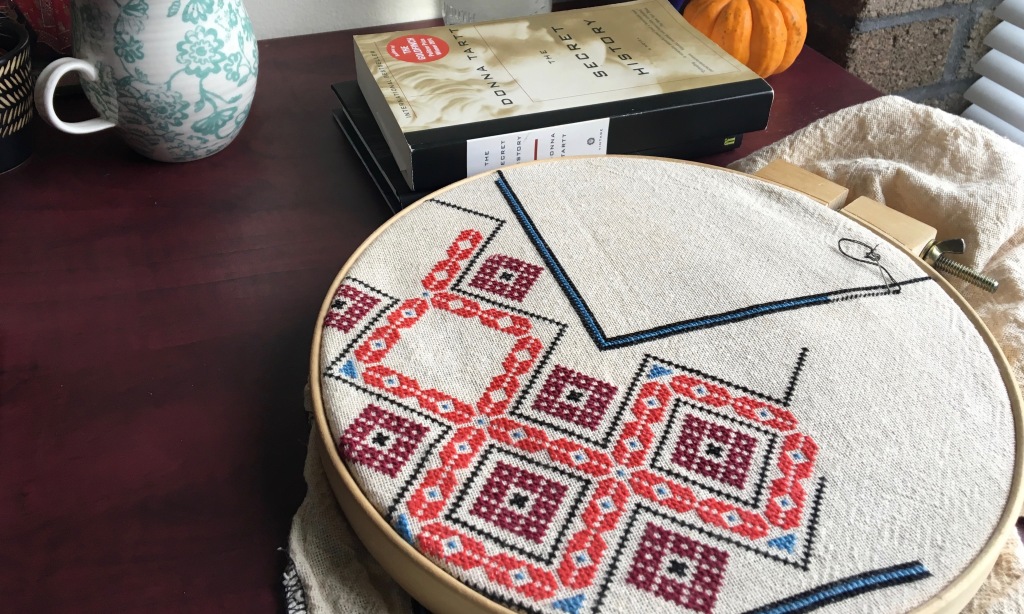
This month I am actually finally going to finish Donna Tartt’s The Secret History. I have been “reading” it for months now, which simply means that I have been stuck at page 396 for months.

The other two books I am reading, 100 Poems by Seamus Heaney (an anthology with short poems and selections of longer works) and Women’s Work: The First 20,000 Years by Elizabeth Wayland Barber, were both given to me as gifts by two of my professors after I was chosen to win the Humanities Paper Prize for two distinctions, an essay and a set of poems. They also gave me another book, Homer by Jonathan Burgess (who I am a great fan of), but I can only read so much at one time! I’m very excited about the Seamus Heaney book because he is one of my favorite poets, and currently my favorite poem of his is either “Postscript” (linked in the sidebar) or “St. Kevin and the Blackbird.” Women’s Work is about exactly what the title says, but with a specific focus on cloth production in very early human history. Of course, I am utterly fascinated by this topic, as I have decided to write my undergraduate thesis on weaving in ancient Greece.

My current project for this month, which I have been working on since the end of last semester, is this cross-stitch which is based on traditional Mediterranean motifs. I got it from Avlea, run by Khouria Krista West. She has all kinds of beautiful designs and patterns, and I want to get one of the Paschal-colored ones eventually.

I brought this project with me on an OCF retreat this last weekend, and everyone loved it, which was really wonderful. I think it is so amazing that people my age are actually so respectful of handcrafts and can find so much beauty and value in them and the time it takes to make them. Also, it was my first below-freezing weekend since the summer started, leaving me with a renewed appreciation for the glory and goodness that is wool.

One last thing I want to share: I submitted some of my poetry for possible publication! I am very excited about this, and of course God only knows what will happen, but even if the poems don’t get printed, I tried something new and I grew a little.

Glory to God for all things!

(I am joining up with Ginny’s Yarn Along here in this beautiful month of October.)

March reads and a knit

IMG_6074 2
So good and so faded… (also some Latin in the corner)

This month is an oddly short one for me, since we get so many days off from school. First a snow day, then Clean Monday, then spring break, then Annunciation… It will be a good month to work on finishing a book (or two) and a knitting project!

The book I have decided to read for Lent is Words of the Heart: Gerondissa Makrina Vassopoulou. It is newly translated, and I am extremely excited for it, since I have been waiting for the translation into English for something like five years. The book consists of a brief biography of Gerondissa Makrina followed by 64 homilies that she gave to her nuns during her time as abbess of the monastery of the Panagia Odigitria in Portaria, Volos. This is so special because there is so little written or recorded spiritual teaching and help from nuns and Gerondissas that this 500-plus page book is truly a treasure. Also, I am of course partial to reading about nuns, so I’m just happy to be able to do that. I am hoping to finish the biography section before Lent starts on Monday, and then read one homily per day until Pascha (since there are so many more than just 40 days until Pascha). I have also decided to use this book for a project for my Literature of Vocation class, so thankfully there go two birds with one stone!

My current fiction book that I am hoping to finish this month is All the Light We Cannot See by Anthony Doerr. I started this book back in January with a friend of mine, and now he is done and I am not (since pesky things like papers and midterms keep getting in the way). Doerr’s use of language and imagery is a delight to read, and I am really enjoying his development of parallel plots. (I’m only on about page 70, so I don’t know how things will develop, but for now this is my opinion.) So far, my decision to step outside of my classics comfort zone and read a Pulitzer winner about World War II has been a good one.

The knitting project that is currently getting most of my attention right now is my So Faded Sweater (pattern by Andrea Mowry). I decided to use a gray/pink/white fade in yarn from La Bien Aimée that was heavily inspired by a palatte that Andrea herself used in a different pattern. This sweater has been so much fun to knit specifically for the beauty and hand of the yarn – I love speckled yarn so much! Every stitch feels like a small surprise, a moment of color that is unique but not overwhelming in its particularity. I suppose it’s the same reason that I love language – the small parts are beautiful and complete on their own but together make a larger whole that is more harmonious for the beauty of the individual bits. In any case, I am looking forward to finishing the sweater, although I’m not sure how much longer it will take me.

Here’s to hoping that March is a month of finishing a few good things and to starting some other more ascetical good things!

{Linking up with Ginny’s wonderful Yarn Along!}