Here we are in October yet again… It is one of my favorite months, and many of my close friends (and my godmother!) have birthdays this month. However, it is also a month of gloominess and usually means that seasonal affective disorder makes my depression worse, so I have to be extra careful about what music I listen to, what books I read, how much exercise I get, and so on.
This month I am actually finally going to finish Donna Tartt’s The Secret History. I have been “reading” it for months now, which simply means that I have been stuck at page 396 for months.
The other two books I am reading, 100 Poems by Seamus Heaney (an anthology with short poems and selections of longer works) and Women’s Work: The First 20,000 Years by Elizabeth Wayland Barber, were both given to me as gifts by two of my professors after I was chosen to win the Humanities Paper Prize for two distinctions, an essay and a set of poems. They also gave me another book, Homer by Jonathan Burgess (who I am a great fan of), but I can only read so much at one time! I’m very excited about the Seamus Heaney book because he is one of my favorite poets, and currently my favorite poem of his is either “Postscript” (linked in the sidebar) or “St. Kevin and the Blackbird.” Women’s Work is about exactly what the title says, but with a specific focus on cloth production in very early human history. Of course, I am utterly fascinated by this topic, as I have decided to write my undergraduate thesis on weaving in ancient Greece.
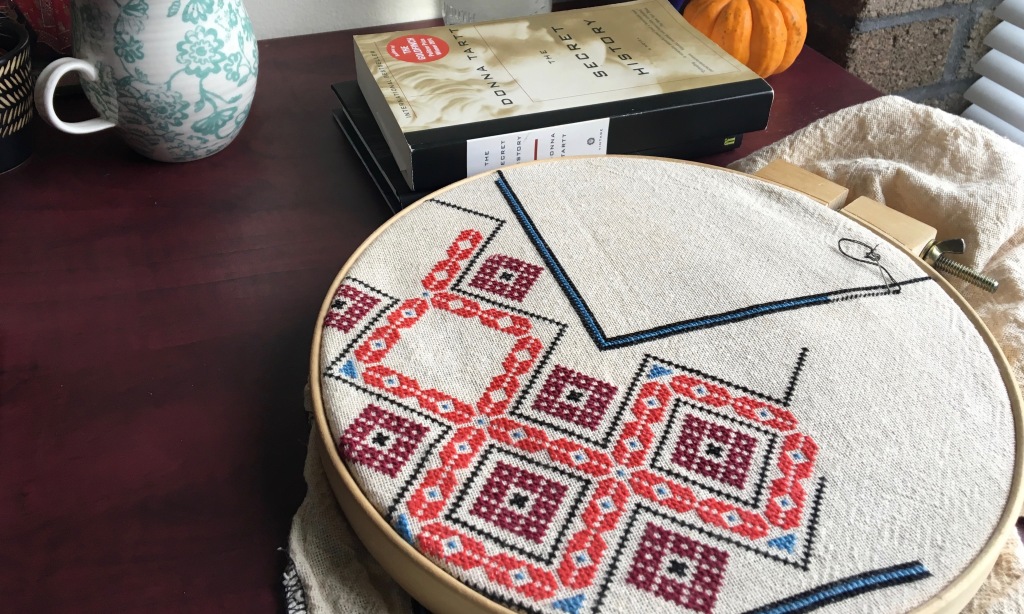
My current project for this month, which I have been working on since the end of last semester, is this cross-stitch which is based on traditional Mediterranean motifs. I got it from Avlea, run by Khouria Krista West. She has all kinds of beautiful designs and patterns, and I want to get one of the Paschal-colored ones eventually.
I brought this project with me on an OCF retreat this last weekend, and everyone loved it, which was really wonderful. I think it is so amazing that people my age are actually so respectful of handcrafts and can find so much beauty and value in them and the time it takes to make them. Also, it was my first below-freezing weekend since the summer started, leaving me with a renewed appreciation for the glory and goodness that is wool.
One last thing I want to share: I submitted some of my poetry for possible publication! I am very excited about this, and of course God only knows what will happen, but even if the poems don’t get printed, I tried something new and I grew a little.
Glory to God for all things!
(I am joining up with Ginny’s Yarn Along here in this beautiful month of October.)
This week I started having scheduled work again after having two weeks off. This was not particularly difficult in terms of the type of work I have to do (I work in a small bookstore), but simultaneously it was spectacularly difficult because I lost a large degree of creative control over my time during the day.
As irritating as this was, I suppose it’s a nice reintroduction into the world of prioritization and scheduling. In my last Sunday post, I wrote about how many obligations I’m going to have, and realistically the only way I am at all going to get through is prioritization, scheduling, and most of all the grace of God.
I think the biggest thing I’m going to have to remember is to slow down and remember God. In his book Becoming a Healing Presence, Dr. Albert Rossi talks about stillness and silence being a form of prayer. He is, of course, harkening back to Elijah’s finding of God not in the thunder, earthquake, or wind, but in the still quiet breeze. Interestingly, we Orthodox actually just read this 5 days ago as the third Old Testament reading for the Vespers of Transfiguration.
I suppose, then, that the only way I can transfigure my time into something positive and God-serving is to find the stillness and the silence and allow it to permeate throughout my day. More accurately, find God in the stillness and the silence and allow Him to permeate my life.
I suppose that’s what Dr. Rossi was really saying and it just took me a while to understand, but then, this is a life-long process, and I am just a beginner.
A peek into the altar area of the church of an abandoned monastery in Albania. Populated monasteries have living stillness, but abandoned monasteries have an entirely different kind of divine angelic stillness, like the place is completely outside of time and is somehow still occupied through prayer.
After I left the monastery about 3 years ago (how on earth has it only been 3 years?), I decided it would probably be a good idea to start working on some kind of a hope chest. I figured that since I would probably someday get married, a hope chest would be a nice tangible manifestation of that dream and hope (and give me something useful to do instead of staring at boys). So far I have a baby blanket, 2 half-finished baby sweaters, and a big pile of yarn.
Which brings us to my most recent knitting project: my second-ever baby blanket which will hopefully be for one of my future children.
I’m using the Fly Away blanket pattern from TinCanKnits, which I also used for the last blanket. It’s a really lovely pattern, and I think my seams on this blanket are better than the last one, so that makes me happy.
The color scheme and design are based on and inspired by Tanis of Tanis Fiber Art‘s beautiful star blanket pattern (here’s the original star; and the idea for me to knit another blanket was totally inspired by her blanket knit-along that she hosts every summer in her Ravelry group).
So here’s to another blanket filled with faith, hope, and love, and the dream of a future family.
There comes a point sometime towards the end of July that I like to call “deep summer”.
Deep summer overlaps a bit with the dog days of summer, which apparently last from mid-July to mid-August (as I just learned from Google). However, deep summer is less of a date-oriented time and more of a feeling.
Deep summer happens when everyone realizes that in a month or so, school and “normal” life will start again, and in response, go into a sort of slower mode of existence in order to preserve as much as possible the luxurious feeling of not having a million things to do. Deep summer means the last chance to go on vacation and the last chance for a family cookout.
Deep summer means autumn is almost here.
With the arrival of autumn comes the arrival of classes and books and groups of people asking everyone in the cafeteria to sign up for intramural flag football (no). The arrival of autumn means I need to make sure I have notebooks and erasers for my mechanical pencil, and also a decent handle on the amount of work I’m going to have to do.
What on earth possessed me to become involved in student government, the leadership of a multi-seminary movement to promote brotherhood and Orthodox unity, the foundation of a creative writing group, and more or less sole responsibility for the proper order of chapel services, in addition to two part-time jobs and 15 credits of classwork, 6 of which are at a different college, the beginning of my undergraduate thesis project, and doctoral applications, in addition to getting a healthy amount of sleep, exercising a little every day, eating properly, having friends, doing hobbies which calm me down and keep me going creatively and introvertedly, and maintaining a decent spiritual life? What possessed me?
Deep summer is here. Hush.
I haven’t yet mapped out my complete class schedule yet because I do not know what it is, which frustrates me rather a lot. I don’t know if I’m even going to get into the classes at the other college, and yet I need them to graduate with my beloved classics major. I’m also not sure yet what graduate programs I’m going to be applying to yet. Simply looking at the list of all I will have going on is overwhelming to me.
Deep summer is here. Hush.
Now my question is, how do I keep this beautiful slow creative happy feeling with me when I start doing all of that stuff? How do I maintain my sanity after the craziness starts?
I think the best answer I can come up with is something my advisor frequently says to me when I am stressed or exhausted: Take care of Catherine for me.
I need to take care of Catherine, and Catherine likes quiet and being creative and cooking and reading every good classics fanfiction book under the sun. Catherine enjoys the profound freedom in reviving her inner toddler and saying no and sticking to it when asked to do something she is not interested in doing.
It’s been a while since I have posted anything on here. There are probably myriad reasons for that, but mostly I think because it is summer.
To me, there is a conception out there that summer is supposed to be relaxing and fun, maybe an opportunity to do some things one would not normally do, and a time to do projects that one does not have time for in the more rushed times of fall and winter and the impending school year.
I find that this is categorically false. Summers are stressful and hard, particularly emotionally, and I live the same meaningless day on repeat until classes start and I again have something to do. Projects go undone and unfinished because I do not have any kind of deadline or reason to finish them, especially since more often than not projects run into the school year when I do not have so much time to finish them.
Perhaps I lack focus or self-discipline; this is most likely the case. However, given my normal schedule during the school year, somehow I doubt this. I have plenty of focus when I want to, and self-discipline, although hard, can be come by when needed.
The worst is probably when I start to question the meaning of everything I am doing. What is the point of researching a random of word usage in Sappho to check on the specific definition of colors when that question literally has no direct meaning or importance to my life?
More deeply and frustratingly, struggles with faith run rampant for me in the summer. What point does church have when every time I try to open myself up to God it seems that He asks of me something that I cannot do? If I cannot change for Him, then why bother going or even praying?
There’s a part of me that feels that one can entirely circumvent the path of spiritual struggle by just not doing it, and this is to some degree true. One does not have to struggle if the demons do not have to fight.
So here I sit on yet another Sunday morning having slept through Liturgy. I think I’m at three weeks running of not having gone specifically to Sunday Liturgy, but more broadly to any Liturgy. I keep sleeping through them. Perhaps I need to go to a real parish (with real people with real lives) and not to the school chapel, but I have no method of transportation. Perhaps I need to pray more on my own, or go to confession, or something.
I’m really not sure what to do, since life without God is loveless and awful, but right now life with God hurts too much for me.
Perhaps I shall write another post about why the summer has been so difficult. This is quite cathartic, and feels less isolating than writing in a journal. Also, as hard as it is, I think that it also is in keeping with the name and theme of “even Thine altars,” because it is easy to think that Christians do not struggle with their faith. The one-and-done confession-and-salvation Protestant mentality is quite pervasive especially in the U.S., but the real question is not “are you saved yet” but rather “are you living your salvation”.
“The springtime of the Fast has dawned, the flower of repentance has begun to open. O brethren, let us cleanse ourselves from all impurity and sing to the Giver of Light: Glory to Thee who alone lovest mankind.”
from the Aposticha of Wednesday Vespers of Cheese Week, third mode
This week in the tradition of the Church is called Clean Week. It is the first week of Lent, which started on Monday and ends with the celebration of the restoration of icons and the end of the iconoclast heresy on the Sunday of Orthodoxy.
The focus this week is on cleaning both the soul and the home in order to prepare for the season of Lent, which is itself preparation for Holy Week, which is preparation for Pascha or Easter. We do like our preparation in the Orthodox Church! Some people prepare for Lent also by keeping an extremely strict fast on the first three days, either by not eating anything, eating very little, or only eating dry food until the Presanctified Liturgy on Wednesday. Since I began Lent with a celebration of the Presanctified Liturgy at one of the parishes in the area, I didn’t see much of a point in doing this, but it is indeed a beautiful tradition. Some say it sets the tone for the entire rest of the fast.
Liturgically, this week is very full, as is the rest of Lent. Here at Holy Cross, we have services in the morning, evening, and night (Orthros, Vespers, Great Compline). The structure of the services changes. Many parts of weekday Orthros change to older hymns, such as Alleluias instead of God is the Lord, hymns to the Trinity (ὔμνοι τριαδικοί) instead of a hymn to the saint of the day, a Martyrikon or hymn for the martyrs as a whole in the mode of the week written for each day instead of a hymn for the specific saint of the day, and the Hymns of Light instead of the Exapostalaria (in Greek these are called Photagogika or φωταγωγικά, which is really fun to say in addition to just being cool hymns). The Hymns of Light are sung three times, first asking for the protection of the commemoration of the day of the week (ie, Monday is angels, Tuesday is St John the Baptist, and so on), second asking for the protection of the Cross, and third asking for the protection of the Mother of God.
In weekday Vespers, the beloved hymns of “Theotokos and Virgin, rejoice Mary full of grace…” and the following are sung instead of hymns for the saint of the day (or apolytikia).
The daily readings during the week shift from being from the Epistles and Gospels to being from the Old Testament, specifically Isaiah, Genesis, and Proverbs. The verses accompanying these readings come from the Psalms, going in numerical order from Psalm 1 onwards throughout Lent, which is one of those neat liturgical details that makes me love typikon so much.
St. Gregory the Dialogist (center), St. Theophanes the Confessor (left), and St. Symeon the New Theologian (right), all commemorated today!
Then, we get the great joy of celebrating Presanctified Liturgies! This service is held to have been composed or at least developed by St. Gregory the Dialogist, also known as the Great, pope of Rome, patron of Gregorian chant and the Gregorian (aka modern) calendar. He lived in the late 6th century and clearly did some amazing things. (Also, in a beautiful divine coincidence, he is commemorated today, March 12!)
“Every day you provide your bodies with good to keep them from failing. In the same way your good works should be the daily nourishment of your hearts. Your bodies are fed with food and your spirits with good works. You aren’t to deny your soul, which is going to live forever, what you grant to your body, which is going to die.”
(some wisdom from St. Gregory)
The Presanctified Liturgy as we know it today is a combination of the structure of Vespers plus a Liturgy with no anaphora, since the consecration of the Gifts takes place during the anaphora, and the Presanctified Liturgy has, well, pre-sanctified Gifts. The consecrated Lamb/Body/bread is set aside with the consecrated Blood/wine on Sunday and are kept in a special place on the Table of Preparation (told you we like preparation) until they are taken from that table to the altar during the Psalter readings at the beginning of the Presanctified Liturgy. (For more information about the Presanctified Liturgy generally, go here.)
Then (because we obviously don’t have enough going on yet), we take Small Compline, that beautiful short evening service that is perfect for just before going to bed, and add a bunch of extra psalms, hymns, and prayers, and produce Great Compline! I honestly think that Great Compline is best experienced rather than explained. It is extremely moving and very beautiful, but most especially when done in the Byzantine style of singing (this is probably the single service that I will contest is the best in Byzantine chant; all the others I will take what I can get). The fathers from the monastery of Simonopetra on Mount Athos have a great recording of it in Greek.
And then, during the first week of Lent, on Monday, Tuesday, Wednesday, and Thursday night, the great canon of St. Andrew is broken into four pieces and added to Great Compline. It is later done in its entirety on Thursday of the Fifth Week, along with the reading of the life of St. Mary of Egypt by St. Sophronius, Patriarch of Jerusalem, which is another whole wonderful discussion for later in Lent….
It’s all quite wonderful and beautiful, and we get a solid six weeks of this liturgical beauty (plus Holy Week after that)! It makes a liturgical geek like me giddy. The Church is watered and fed by this liturgical downpour just like all the flowers outside are watered and fed by the snowmelts and rainstorms and spring sunshine.
Pray for me!
Kali Saracosti! Good Lent!
And of course, Kali Anastasi! Blessed Resurrection!
So good and so faded… (also some Latin in the corner)
This month is an oddly short one for me, since we get so many days off from school. First a snow day, then Clean Monday, then spring break, then Annunciation… It will be a good month to work on finishing a book (or two) and a knitting project!
The book I have decided to read for Lent is Words of the Heart: Gerondissa Makrina Vassopoulou. It is newly translated, and I am extremely excited for it, since I have been waiting for the translation into English for something like five years. The book consists of a brief biography of Gerondissa Makrina followed by 64 homilies that she gave to her nuns during her time as abbess of the monastery of the Panagia Odigitria in Portaria, Volos. This is so special because there is so little written or recorded spiritual teaching and help from nuns and Gerondissas that this 500-plus page book is truly a treasure. Also, I am of course partial to reading about nuns, so I’m just happy to be able to do that. I am hoping to finish the biography section before Lent starts on Monday, and then read one homily per day until Pascha (since there are so many more than just 40 days until Pascha). I have also decided to use this book for a project for my Literature of Vocation class, so thankfully there go two birds with one stone!
My current fiction book that I am hoping to finish this month is All the Light We Cannot See by Anthony Doerr. I started this book back in January with a friend of mine, and now he is done and I am not (since pesky things like papers and midterms keep getting in the way). Doerr’s use of language and imagery is a delight to read, and I am really enjoying his development of parallel plots. (I’m only on about page 70, so I don’t know how things will develop, but for now this is my opinion.) So far, my decision to step outside of my classics comfort zone and read a Pulitzer winner about World War II has been a good one.
The knitting project that is currently getting most of my attention right now is my So Faded Sweater (pattern by Andrea Mowry). I decided to use a gray/pink/white fade in yarn from La Bien Aimée that was heavily inspired by a palatte that Andrea herself used in a different pattern. This sweater has been so much fun to knit specifically for the beauty and hand of the yarn – I love speckled yarn so much! Every stitch feels like a small surprise, a moment of color that is unique but not overwhelming in its particularity. I suppose it’s the same reason that I love language – the small parts are beautiful and complete on their own but together make a larger whole that is more harmonious for the beauty of the individual bits. In any case, I am looking forward to finishing the sweater, although I’m not sure how much longer it will take me.
Here’s to hoping that March is a month of finishing a few good things and to starting some other more ascetical good things!
On Sunday 10 February I went to the Boston Farm to Fiber Festival at the Boston Public Market, which I had been excited to go to since I found out about it a week before. And it was amazing! I had never been to any kind of fiber or yarn festival before, and this was a good first place to start – easy to get to, a good but not overwhelming number of vendors, cool swag at the end of the day, and a great friend to keep me company.
Taproot swag from their stand at the Fiber Festival!
One of the festival’s sponsors was the Taproot Magazine, which I thought was fabulous since last year I bought one of the back issues, “Heal.” I have since read it cover to cover several times. (This isn’t hard to do since there are no ads, hooray for independent publishing!) At the festival, I got last year’s set of back issues, which I am over the moon for (I mean, just look at that cover art).
This magazine, combined with a few podcasts that I’ve been listening to, have made me start thinking a lot about where my yarn comes from. I love to knit, and I certainly do not knit with all yarn indiscriminately. However, even with beautiful hand dyed yarn from indie dyers, a question remains about the source of the yarn. Clearly wool comes from sheep, but where do the sheep come from? Are they local to me? How are their shepherds and caretakers living? The wool must then be processed – where is this done? Is it done sustainably? Or, like most superwash wool, is it coated in plastic in a process that is quite bad for the environment?
These are some serious questions with serious implications! And they go not just for sheep, but for alpaca and llama and all other fiber animal (including, oddly, the silkworm).
I’ve been thinking about the whole yarny process for probably a year and a half now, and I have no easy answers. I love beautiful hand-dyed colors on superwash wool, I love the hand, and I love the sheen. However, I have not been ready to make a full commitment to buying locally made (in the U.S.) sustainably produced non-superwash wool, because while this is a good and beautiful thing, it limits my yarn options drastically.
So the question I have to ask myself is: which option makes me a better steward and caretaker of this beautiful planet God has made?
This is the question I have to think about and answer at some point. For now, I think I’ll stick with natural and non-superwash fibers but also keep using all those indie-dyed yarns I have in my stash.
I’ll definitely do more thinking about this and post about it more in the future.
Until then, I will hunker down and enjoy my half snow day with knitting and tea and an artificial fire.
Also look at this beautiful bag from Woodsy and Wild (holding an all-new set of Taproot)!
The church of an old abandoned monastery in Albania (photo taken 29 May 2018)
The services of ninth hour and vespers have always been particular favorites of mine, perhaps because they are a release from the toils of the day. The reader begins the appointed psalms, and my entire being relaxes.
It probably comes as no surprise then that my favorite psalm is the first psalm read at ninth hour – Psalm 83.
To me, this psalm encapsulates my struggle and my life. It focuses on the joy and goodness of God, the God who Is, but it does not neglect that life includes sorrow and weeping. It says that God is my home.
My life recently went through quite a bit of spiritual upheaval, so when I decided to start a blog, I wanted to name it something that would remind me of God, that He is my home and my shelter. So, I chose “Even Thine Altars.” You can find it in the fourth line of the psalm, posted below.
On the altar of the Lord of hosts, we are home. On the altar, in the chalice, we belong to the body of Christ, the Church, our home.
How beloved are Thy dwellings, O Lord of hosts; my soul longeth and fainteth for the courts of the Lord.
My heart and my flesh have rejoiced in the living God.
For the sparrow hath found herself a house, and the turtledove a nest for herself where she may lay her young,
Even Thine altars, O Lord of hosts, my King and my God.
Blessed are they that dwell in Thy house; unto ages of ages shall they praise Thee.
Blessed is the man whose help is from Thee; he hath made ascents in his heart, in the vale of weeping, in the place which he hath appointed.
Yea, for the lawgiver will give blessings; they shall go from strength to strength, the God of gods shall be seen in Sion.
O Lord of hosts, hearken unto my prayer; give ear, O God of Jacob.
O God, our defender, behold, and look upon the face of Thine anointed one.
For better is one day in Thy courts than thousands elsewhere.
I have chosen rather to be an outcast in the house of my God than to dwell in the tents of sinners.
For the Lord loveth mercy and truth, God will give grace and glory; the Lord will not withhold good things from them that walk in innocence.
O Lord God of hosts, blessed is the man that hopeth in Thee.
Psalm 83, The Psalter According the the Seventy, Holy Transfiguration Monastery




 Even Thine Altars